When life tightens, something inside you often speaks first.
You’ve already started noticing what happens under pressure. Now listen for what happens underneath it. Not audible voices. Internal ones.
- The voice that explains what just happened.
- The voice that warns you not to mess this up.
- The voice that tells you to try harder, smooth it over, disappear, or take control.
- The voice that decides what this means about you.
They’re disappointed in me.
I need to fix this.
Don’t let them see you struggle.
Just get through it.
You can’t depend on anyone.
Get out of here.
These voices don’t appear randomly. They have histories. They formed under real conditions—responsibility, expectation, fear, disappointment, loss. At some point, what they said may have helped you make sense of what was happening or decide what to do next.
Eventually, you may have stopped hearing them as voices at all. They simply sounded true. And under pressure, one of them may still be the first to speak. Before trying to silence it, argue with it, or replace it, begin by noticing:
What’s taking the lead?
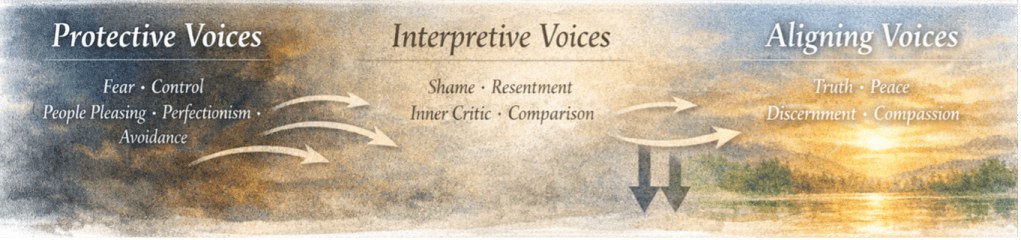
What These Voices Are
These voices are not imaginary.
They are not character flaws.
They are not diagnoses.
They are internal authorities—ways your system learned to interpret reality, protect itself, and keep moving when something mattered.
Some voices mobilize you.
Some manage perception.
Some retreat.
Some decide who you are.
Over time, because they work, they become familiar.
Because they are familiar, they begin to feel like you.
Pressure doesn’t create these voices.
Pressure reveals which one is leading.
Why Noticing Matters
You can understand yourself clearly and still react in ways you don’t agree with.
That’s not hypocrisy.
It’s hierarchy.
The voice that speaks first under pressure often decides before reflection arrives.
When that voice goes unnamed, it sounds reasonable. Its urgency feels justified. Its explanation feels true.
This work doesn’t try to silence voices or replace them.
It helps you notice which voice has authority—and what shifts when that authority changes.
What These Pages Are (and Aren’t)
Each voice page stays close to lived experience.
You’ll find:
- how the voice typically sounds
- what it’s trying to protect or preserve
- how it gains authority under pressure
- what quietly changes when something else leads
You won’t find steps, techniques, or corrections.
This is about seeing, not fixing.
How to Begin
Begin with the voice that feels familiar—or uncomfortable.
You don’t need to identify with all of them.
You don’t need to apply anything yet.
Pressure will make clear which one feels closest.
Recognition is enough for now.
You don’t fall apart under pressure.
You respond to the voice that learned how to help you survive.
- Protective Voices
When something feels at risk - Interpretive Voices
When meaning starts making decisions - Aligning Voices
When pressure no longer dictates

